The ecology and behavior of hosts helps establish the selective environment for pathogens.
6.1 The Crisis of Antimicrobial Resistance
Why do we have a crisis? A very real contributor to the problem relates to the economic incentives for pharmaceutical companies (Kremer and Snyder 2015).
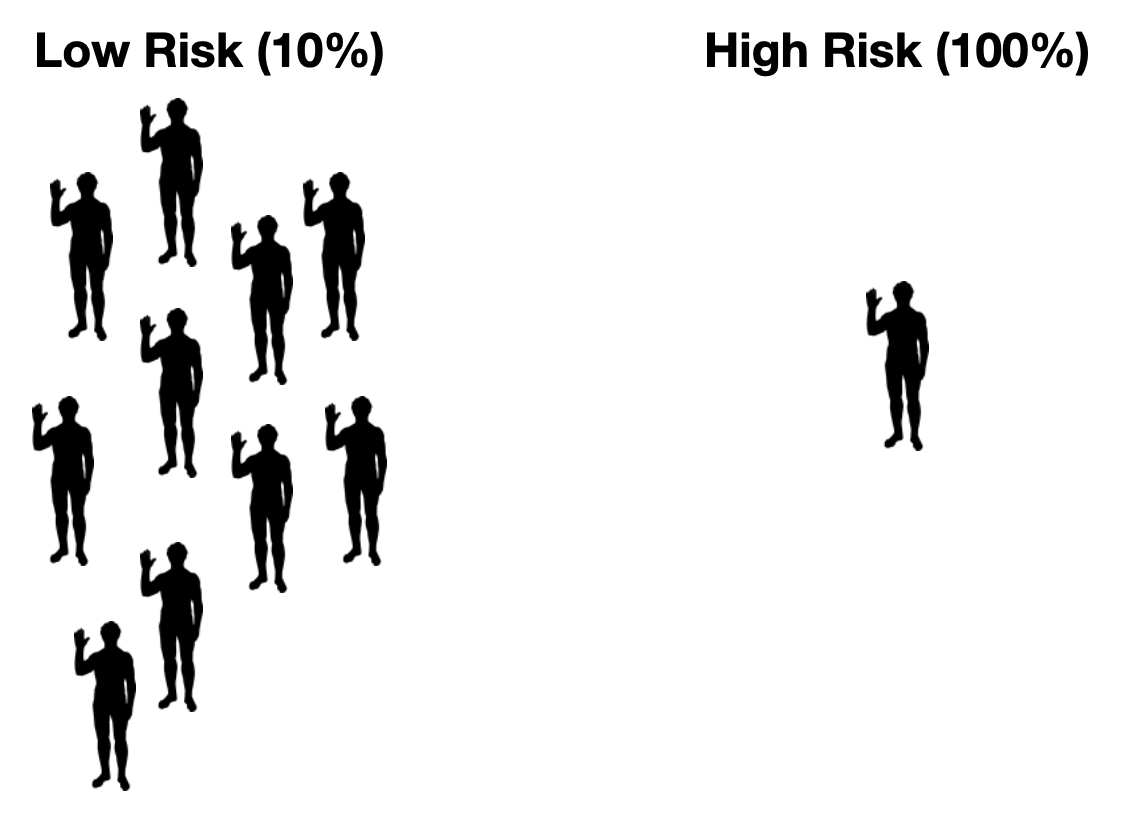
Consider a population of 100 people, 90 of whom have a low disease risk, say 10%. The remaining ten have 100% chance of getting infected. The infection generates harm equal to the loss of $100 and both treatment pharmaceuticals or vaccines are costless to produce, administer, and are 100% effective. Assume people are risk neutral and economically rational (big assumptions, I know).
This means 19 people will get infected on average.
Low-risk population loses an expected $10 (10% chance x $100 loss). High-risk population loses $100.
Economic theory tells us that the low-risk people should be willing to pay $10 for a vaccine. Note also that the Pharma company doesn’t know a priori who is high-vs.-low risk. This means $10 x 100 = $1000 revenue.
However, economic theory also tells us that anyone infected (regardless of their subpopulation) should be willing to pay $100 to treat their disease. This means $100 x 19 = $1900.
Frank, S. A. 1996. “Models of Parasite Virulence.”Quarterly Review of Biology 71 (1): 37–78. https://doi.org/10.1086/419267.
Kremer, Michael, and Christopher M. Snyder. 2015. “Preventives Versus Treatments.”The Quarterly Journal of Economics 130 (3): 1167–239. https://doi.org/10.1093/qje/qjv012.