Last Fall quarter, I co-taught a new graduate seminar on human ecology with Xavier Basurto. Human ecology is the first course in the graduate core sequence for Environmental Behavioral Sciences PhD students. We somehow never seemed to have enough time to cover all the topics that we wanted to discuss and I ended up writing a series of quite long discussions on the course’s Canvas site. I was reminded of these yesterday while preparing for another lecture and decided I should rescue them from the obscurity of a archived Canvas page accessible to ten people. This is the first of those.
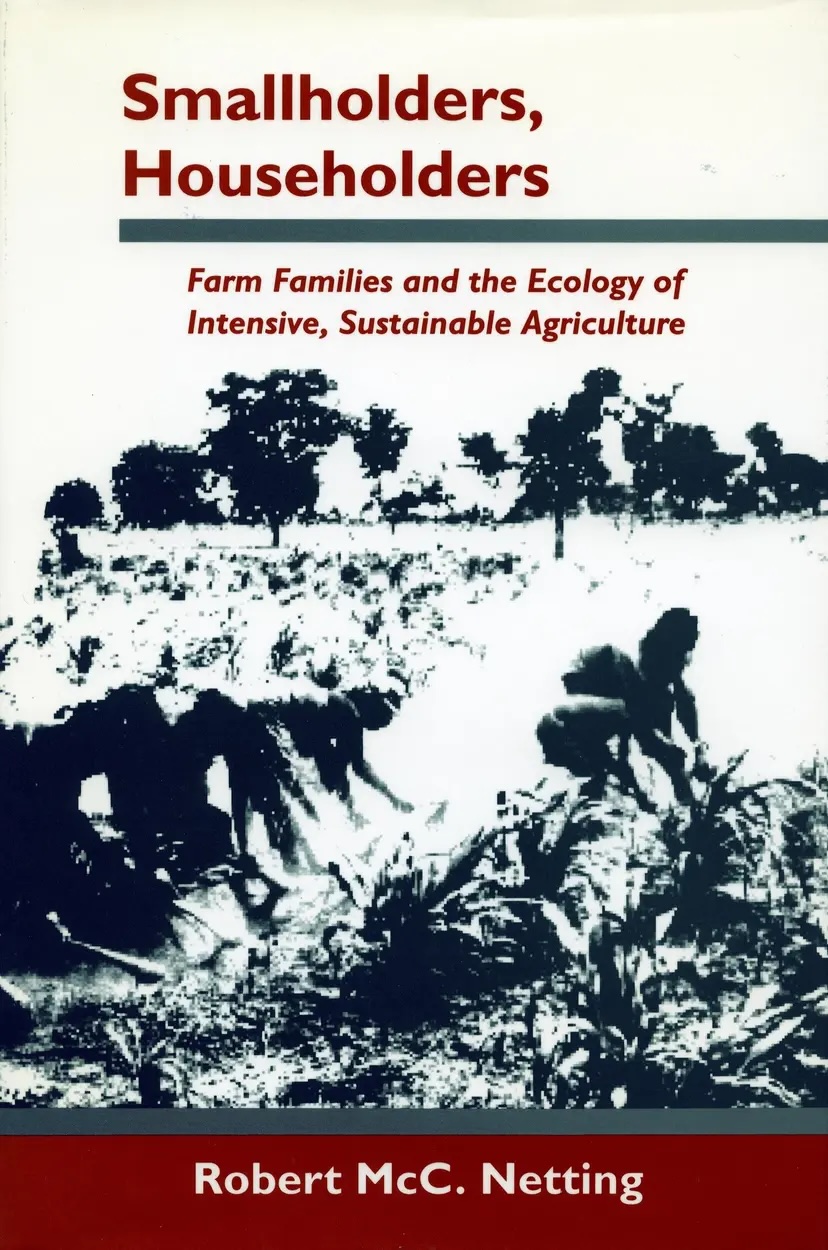
Xavier assigned Bob Netting’s (1976) Human Ecology paper, “What Swiss Peasants Have in Common” midway through the quarter. I had already included Smallholders, Householders (Stanford University Press) in a previous week when we talked about population and agriculture (which also included Ron Lee’s masterful (1986) essay on Malthus and Boserup, a paper that definitely deserves its own blog post). Netting was always a bit of an intellectual hero for me, so I thought I’d add a little context on him as a scholar that week. Here’s what I said:
Bonnie McCay wrote a wonderful remembrance of Robert Netting, who wrote this week’s cool reading on what alpine peasants have in common. I thought it was worth sharing because she gives a really nice, concise history of cultural ecology, highlighting the sorts of questions that people asked in the various forms of ecological anthropology or human ecology.
I love the point she makes about the arguments from his (1993) book, Smallholders and Householders, that frontiers are not common property institutions and that the problems of frontiers arise from the very different incentive structures on peripheries vs. in the core. He also provides a powerful critique of the Neo-Malthusians, noting that population growth per se is not always (typically?) the cause of environmental degradation; that, in fact, such degradation is more likely on frontiers which are sparsely populated and where labor is often coerced.
One of the great things about Smallholders is the way that he engaged with both Boserup (from week 3) and Ostrom (the rest of the weeks). Anthropologists (particularly of his generation) have a bad habit of becoming ossified in their beliefs. I know everyone does, but the problem is particularly acute in Anthropology. Netting bucked this trend, as Bonnie McCay noted in her remembrance, enthusiastically taking on new ideas from other fields. In this way, Netting has always been an inspiration for my approach to research.
In the introduction to Smallholders, Netting described the type of work he did: “an empirical social science of practical reason, grounded in an Enlightenment faith that there are regularities in human behavior and institutions that can be understood … These commonalities can be discerned cross-culturally in groups separated by space and time and displaying a splendid variety of cultural values, religions, kinship systems, and political structure.” Again, this is an approach to research to which I aspire.
A final thing I will say about my appreciation of Netting is his skepticism of (bad) evolutionism. When McCay uses the term, she means something quite historically specific. The social evolutionists were an early school of thought in ethnology. The ideas started with people like Lewis Henry Morgan, with his three stages of human development: Savagery, Barbarism, and Civilization (fun game: guess which one of those is the best!). The evolutionists didn’t know much about actual evolution. They had this idea that culture was mainly a function of diffusion. Ideas moved from more civilized to less civilized populations and were transformed in the process of diffusion. Note that Netting’s full-throated defense of the (ecological) rationality of the smallholder is a direct response to this quite racist idea. The idea that there is a very clear logic underlying the mixture of communal and private property rights in Törbel is another manifestation of this. Evolutionary ideas are obviously important for my thinking, but I also recognize that there are few things worse than bad evolutionary theory. The good news is that most of the bad “evolutionary” ideas come from people who know very little about how evolution actually works. The bad news is that the general public’s (and most anthropologists’) understanding of evolution is so poor that they are easily misled.
References
Lee, R.D. 1986. Malthus and Boserup: A Dynamic Synthesis. In The State of Population Theory, edited by D. Coleman and R. Schofield. New York: Blackwell.
McCay, B.J. 1996. Robert McC. Netting and Human Ecology: An Appreciation. Human Ecology. 24 (1):125-135. (http://www.jstor.org/stable/4603188)
Netting, R.M. 1976. What Alpine Peasants Have in Common: Observations on Communal Tenure in a Swiss Village. Human Ecology. 4(2): 135-146. (doi:10.1007/BF01531217)
Netting, R.M. 1993. Smallholders, householders: Farm families and the ecology of intensive, sustainable agriculture. Stanford: Stanford University Press.