Elite Anthropology Departments Are Overwhelmingly Humanistic
I am anthropologist—both by training and by subjective identity—and I am unhappy, bordering on despairing, about the current state of my field. In addition to being an anthropologist, I am a scientist. Anthropology, which Eric Wolf characterized in 1964 as being “both the most scientific of the humanities and the most humanistic of the sciences,” is now dominated by purely humanistic scholars. Well, this is at least true in elite anthropology departments.
We are in a moment, alas, when anthropology is back in The Discourse™️ about higher education and the academy more broadly with the release of Vanderbilt Report on the State of Scholarship and various articles in the Chronicle of Higher Education, Inside HigherEd, and more. I am not sanguine that the latest skirmish in the culture wars is going to do any good. Moreover, I’m quite concerned it will do real harm, if not to anthropology, then to higher education in general, providing ammunition for enemies of higher ed to close down departments in the humanities and the social sciences. I have a lot more to say about this topic, but in this post, I will restrict myself to explaining my take on what has happened to anthropology.
About five years ago, I had a correspondence with a number of anthropologist colleagues that was started by a couple different publications at the time as well as some tweets, back when Academic Twitter was still a thing. Here are a couple screenshots of a conversation between the race scientist Charles Murray and evolutionary psychologist Geoffrey Miller. This exchange caught my attention because Miller cited my PhD advisor, Richard Wrangham, as a paragon of scientific anthropology. (as an aside, I’ll note that the instigating tweet, that some Columbia master’s student doesn’t believe in numbers, gives urban-legend of the same genre as kids who “identify as cats” being given litter boxes in school) I suppose it was also around the time that I interviewed Richard for the CASBS podcast. I believe I teasingly sent these screencaps to him, asking him if his ears had been burning.
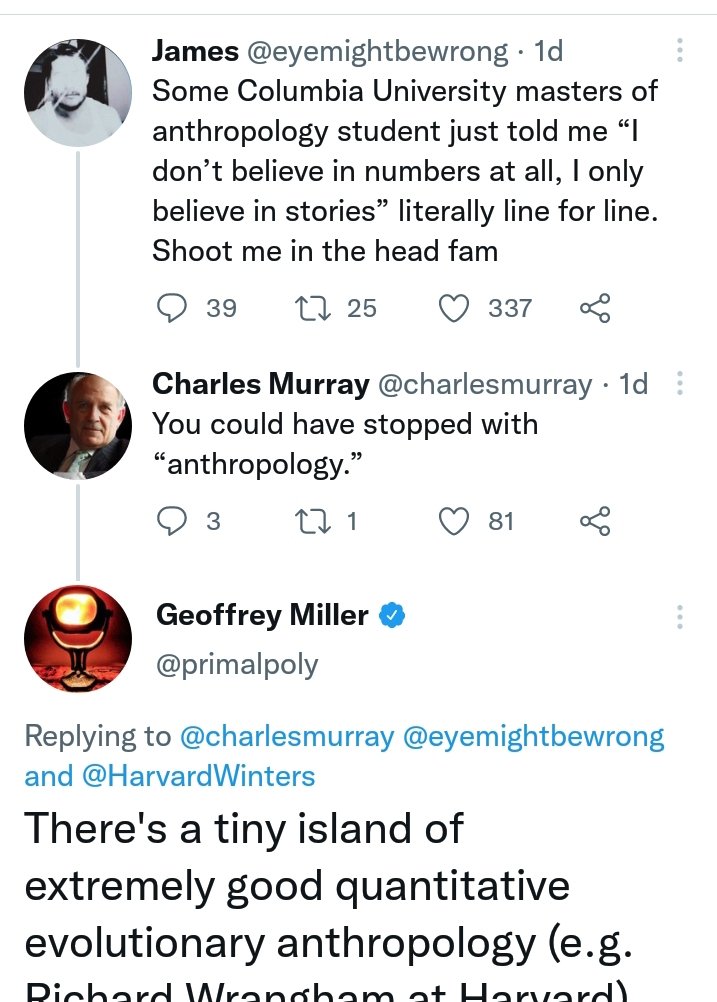
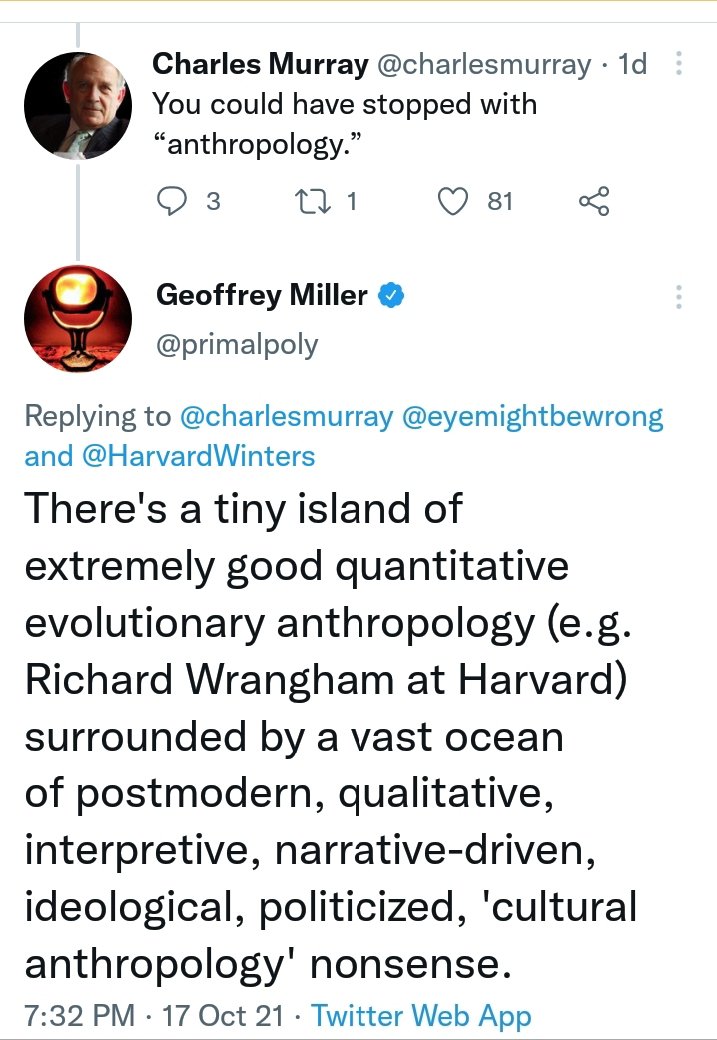
I think that the most vocal critics of contemporary anthropology, including Murray and Miller, don’t understand the field and are simply giving it a sympathetic read vis-à-vis their own reactionary political priors. It’s no great secret what the politics of these two are.
The criticisms from these observers, and from panels such as the Vanderbilt report, generally focus on the issue of truth. In The Blank Slate, Pinker wrote of what he called—following Tooby and Cosmides (1992) in The Adapted Mind—the Standard Social Science Model (SSSM): “The idea that truth is an objective property of assertions that match the world is rejected as a quaint holdover from the Enlightenment.” Murray himself frames the problem of the post-modernists (whoever they may be) as “hostility to the idea that an objective truth exists.” Truth gets replaced by political ideology. So their narrative goes.
However, the problem with anthropology is not really one of post-modern cultural anthropologists who hate truth versus a valiant rear guard of hold-out, apolitical scientists. There’s the fact that the self-styled truth-tellers are hardly apolitical, but it’s also true that the cultural anthropologists don’t actually hate truth.
What’s really going on is a matter of elites vs. everyone else and the elite anthropology departments are dominated by humanists who score professional points every time they make some outlandish anti-science statement. This Michael Clune essay from 2018 really captures this dynamic well, albeit for a cognate group of humanists. Cultural anthropologists in what we might call “blue-collar” departments are not only sympathetic to science, they are innovating new modes of interdisciplinary and applied research.
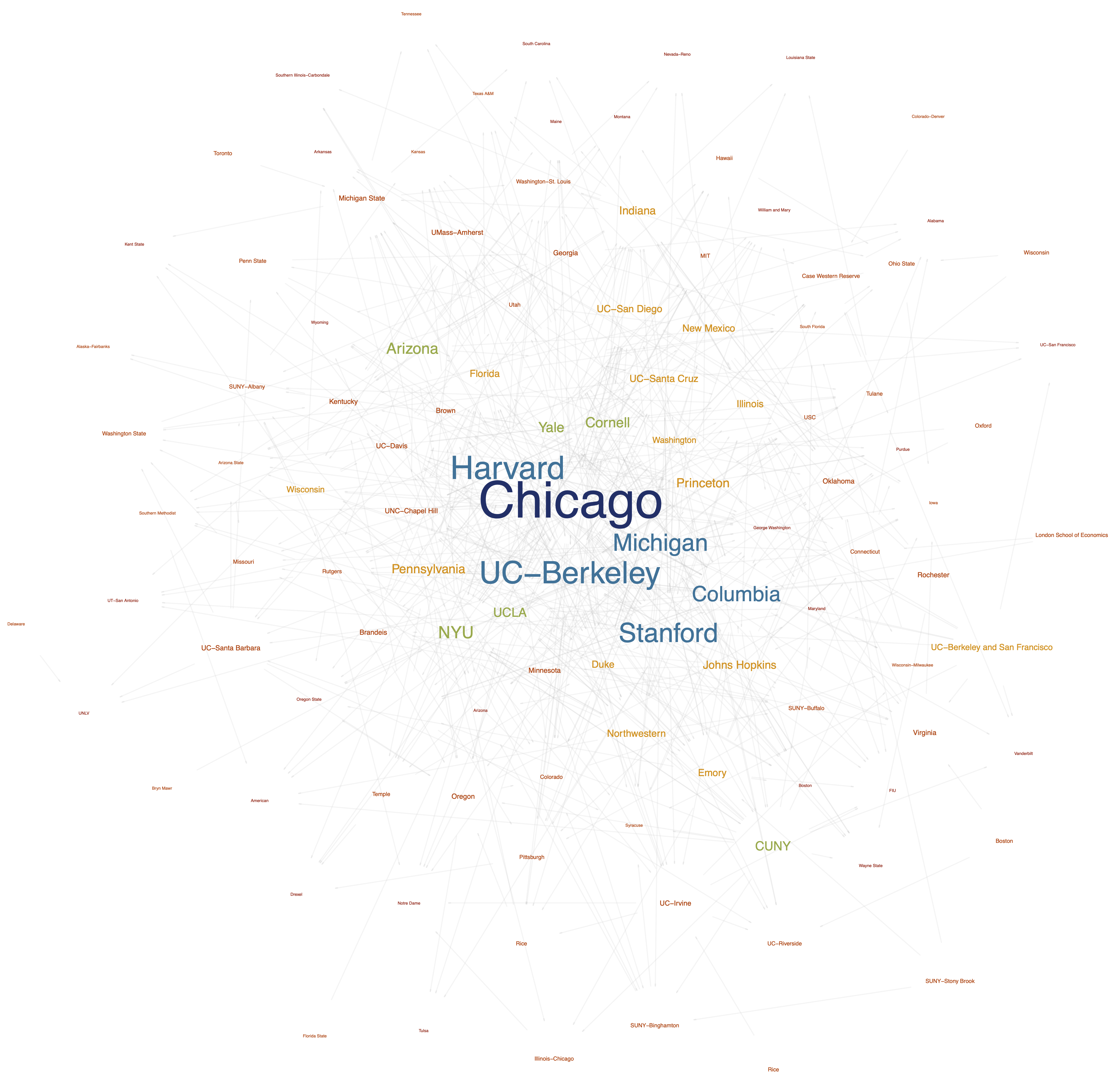
The problem is that our discipline is so dominated by the elites. Nick Kawa and colleagues (2019) analyzed the hiring network for cultural anthropology at PhD-granting universities in the US, based on data collected by the American Anthropological Association, what should be the umbrella organization for the field (but which has systematically alienated archaeologists, biological anthropologists, and nonconformist cultural anthropologists). Kawa and colleagues’ most interesting result, in my reading, was an asymmetry measure on the network. It measured if institution \(i\) hires a PhD from institution \(j\), how likely is \(j\) to hire from \(i\)—essentially, a measure of non-reciprocity in hiring. A group of institutions stand out. Chicago has an asymmetry of 0.985 (max=1). Harvard and Berkeley are 0.982. It falls off quite a bit from there (e.g., Stanford=0.875), but there is a group of 10 that clearly form a core that seems safe to identify as the elite core of our field. The full list of ten is:
- Chicago
- Harvard
- UC Berkeley
- Michigan
- Stanford
- Princeton
- Columbia
- Penn
- NYU
- Yale
From Kawa’s data set, fully 107 out of the 940 faculty with known PhD institution (11.4%) received their PhD from the University of Chicago (out of 87 unique PhD-granting institutions). That’s 65% more than the next highest PhD granter (Harvard). The ten high-prestige schools listed above account for 448 of the faculty, nearly 50%. This number rises to 459 if we count graduates of the joint Berkeley-UCSF program in medical anthropology in the list of elite graduates. This is why elite preferences matter for the field.
Critics of anthropology like Charles Murray, Nicholas Wade, Geoffrey Miller, Steve Pinker, et al. see some sort of identity politics driving changes in anthropology. That is, rigorous truth-seeking has been replaced by ideologically-motivated political work. This is the place in the discourse where causality weenies like me interject: remember, correlation doesn’t imply causation. In a future post, I will expand more on the causal weakness of the critiques of anthropology and other humanistic social sciences. For now, I’ll simply say that I see the changes in anthropology as just reflecting venal, within-field professional politics. It’s politically and rhetorically expedient for critics to instead characterize this shift as a forsaking of objectivity, rigor, and truth. By dismissing anthropologists as just a bunch of wacko post-modernists, they can safely ignore legitimate critiques of their work coming from often scientifically-sophisticated anthropologists (especially anthropological geneticists).
“Post-Modernist”: The Problematic Term
Many anthropologists who maintain a more scientific epistemology and naturalistic-rational methodological bent refer to their intellectual adversaries as “post-modernists.” I don’t care for the term for a number of reasons. Part of this is that people we might label as such frequently don’t see themselves that way. Back when I was in the anthropology department, I had many conversations with the late Jim Ferguson, who employed Foucauldian theory in his work, but thought it laughable to be called a post-modernist. The bigger problem though is that the term is so imprecise. This should bother us more, as scientists, than it seems to. What does it mean to be a “post-modernist”? One of the few explicit definitions of post-modernity was articulated by Lyotard in his (1979) book, The Postmodern Condition. The key element of the post-modern condition, according to Lyotard’s view, is skepticism toward metanarrative, where a metanarrative is a grand, typically teleological, narrative that tends to provide society, institutions, nation states, etc. with their legitimacy. Think Enlightenment or Marxism. If skepticism about metanarrative is what constitutes a post-modernist, then I maybe I am guilty of being a post-modernist. As an arch adaptationist, I am very much against any sort of grand teleology of progress. Adaptation is local, contingent, and doesn’t care about ultimate goals. Wow, super-awkward.
The differences between the work of contemporary humanistic cultural anthropologists and anthropologists of a more scientific persuasion may be related to the broader post-modern moment, but it comes about more through ontology than epistemology. A researcher’s ontology is what they think is out there to be explained. It turns out, contemporary cultural anthropologists are not interested in understanding the origin and diversity of the species Homo sapiens, how we adapt, what unites us, etc. The cultural anthropologist’s remit is substantially smaller. I can’t say that I really understand what it actually is, and it’s very difficult to generalize about a subject that sees generalization as an epistemological hazard! There are a couple things that come to mind though. One is literally about dismantling universals and other regularities—“denaturalizing.” An automatic, across-the-board disdain for generalization, of course, is fundamentally anti-scientific since generalization is a key element of scientific explanation. That said, I think there is plenty of room in science to call into question, with empirical evidence, beliefs that have been naturalized for ideological or other reasons. Other themes of contemporary cultural anthropology are less inherently anti-science. One obvious theme is understanding subjectivity, which is seen as being more than just an interior state, but is something that is actively constructed. I also see vaguely network ideas coming through in the ubiquitous focus on power. Power is enacted through nodes in society that are created through the friction-generating interactions of people, institutions, and technologies. To be totally honest—and, no doubt, my erstwhile colleagues in the anthropology department would be horrified—it kind of reminds me of what (sociologist/physicist/arch-formalist) Harrison White talks about in his (1992) classic, Identity and Control: “Identities spring up out of efforts at control in turbulent context… An identity emerges for each of us only out of efforts at control amid contingencies and contentions in interaction. These control efforts need not have anything to do with domination over other identities. Before anything else, control is about finding footings among other identities. Such footing is a position that entails a stance, which brings orientation in relation to other identities.”
Thinking about the shift away from science as being more ontological than epistemological helps explain why the “post-modernist” who we accuse of not caring about Truth, nonetheless cites facts in making arguments (sometimes, at least). It’s not that they don’t believe in truth (at least with a small “t”), it’s that they see what anthropology explains as something very different from what I do. This helps me understand why AAA president, Carolyn Rouse can make some of the claims she does in her bizarre recent interview in The Chronicle of Higher Education, talking repeatedly about “settled science.” How can science be settled in the mind of someone who isn’t supposed to care about truth? Well, questions of whether science is ever actually “settled” aside, it’s because Rouse in not anti-truth; she just has very different ontology of anthropology than I do or Joe Henrich does or Rebecca Bird does, and so on.
The Culture Wars in Anthropology Are About In-Group/Out-Group Politics
I see the whole decline of science in anthropology (and, to an extent, other social sciences) as venal academic politics. Humanistic cultural anthropologists out-competed scientific anthropologists and continue to play their advantage against us by dominating elite PhD-granting programs.
Science is costly. Not only does it cost money to do scientific research, there are huge opportunity costs of doing the empirical research. These opportunity costs are particularly steep in anthropology, where you have to spend months/years in the field gathering high-risk data about things that funders are, at best, lukewarm about. Turns out that if you’re not constrained by data, you can write a lot of books of vaguely political criticism, written in a style so opaque that it takes hundreds of graduate seminars run in parallel to make any sense of them. Then you have a small army of people who, Concorde fallacy or no, are committed to foist this nonsense on their own future students (they had to do it; they’ll be damned if these entitled students don’t have to as well).
This asymmetry has consequences within the university. As the old adage goes, we’re not sure that the dean can read, but we’re pretty sure they can count. When you don’t have to do all that inconvenient fieldwork, you can write a lot. And when your writing is independent of increasingly difficult-to-obtain research funding, you’ve got a second major advantage. When deans compare someone like this to a scientific anthropologist (who doesn’t even have a book!), with ignorance of the substance of the subject matter, you’ve got the selective milieu for anti-science to take over the field.
There is another asymmetry that I believe was essential to the establishment of the hegemonic elite preferences for humanistic anthropology. On the one hand, I suspect that many humanists outside of anthropology found the humanistic work that coalesced around, for example, Clifford and Marcus’s (1987) Writing Culture, really exciting. This created buzz and, more importantly, coalitions within universities and the academy as a whole. Jim Ferguson described a process very consistent with this at his previous institution, UC Irvine. UCI went from being a very scientific (though notably non-evolutionary) anthropology department, populated with great scholars such as Kim Romney, Doug White, John Boyd, to one of the most humanistic—dare I call it “post-modern?—departments in the country. The element that most propelled this transition was, according to Jim, the formation of alliances between humanistic anthropologists and humanists and other humanistic social scientists throughout the university.
On the other hand, more scientific anthropology lost much of its status as the hyphenated anthropologies—economic-, political, psychological-anthropology—became less relevant toward the end of the 20th century. These specialties lost their relevance because they were no longer the brokers of esoteric knowledge about how people in other cultures made their livings or organized their societies or thought about the world. You see, the actual disciplines, like economics, political science, and psychology, developed their own field traditions, closing the structural hole filled by anthropologists in the post-war growth of the social sciences. The hyphenated anthropologists were no longer needed and the other disciplines, which typically enjoy greater status in the academy, eclipsed much of the anthropologists’ work.
So, I don’t see a great conspiracy of, what Jordan Peterson comically calls, in barely rehabilitated Cultural Bolshevism, “Marxist post-modernists.” I see base academic politics.
I want to be very clear as I conclude here. I am generally not a fan of contemporary cultural anthropology as practiced in elite universities. I would like to see a greater diversity of approaches to the broad study of humankind in these institutions. I would like to see an American Anthropological Association that truly represented the interests of the breadth of its discipline. I also happen to think that if we want to heal from the pathological present condition, we need to understand both what caused our current state and what maintains it. I find the facile narrative that disinterested inquiry and rigor were displaced by the woke politics of people who don’t care about truth to be unhelpful at best and, more realistically, very likely aiding the real reactionary enemies of higher education—including science!
I have a lot more to say on this topic, but I will save that for another post.